
SOLD OUT
Gloves
Hunting gloves protect your hands from cold, wind and rain while keeping the finger feel you need for a clean shot. This category holds Härkila, Seeland, Browning, Chevalier and Alaska models, from thin stalking gloves to heated winter pairs in green and camouflage.
Gloves
Your hands freeze first on a hunt. The best jacket will not help you when your fingers stop obeying and you can no longer load quietly or feel the trigger. Hunting gloves keep out cold, wind and moisture while leaving your palm the sensitivity a shot demands. In this category you will find Härkila, Seeland, Browning, Chevalier and Alaska gloves: thin pairs for active hunting, waterproof pairs for autumn rain and heated pairs for long hours in the high seat.
How hunting gloves differ from ordinary gloves
Hunting gloves differ from ordinary winter or work gloves in colour, quiet outer fabric and a palm built for holding a firearm. Green, brown or camouflage tones blend with the rest of your clothing, the material does not rustle against the stock, and your fingers stay free enough to feel the trigger in frost. Small things decide much in the forest: a pale glove raised to your binoculars catches a deer's eye faster than your face does. The Chevalier No Slip model has a grip palm that holds the rifle steady even with wet hands, and Browning Tracker and Prohunter gloves are cut so the index finger reaches the trigger without resistance. Details like these separate a hunting glove from a ski glove that warms you but ruins the shot.
Glove types by season and hunting style
The category covers five main types: thin gloves for active hunting, camouflage gloves for stalking, waterproof membrane gloves, warm winter gloves and mittens, and heated gloves for the coldest days. Each type matches a different season and hunting method, which is why most hunters keep several pairs and switch between them through the year.
Thin gloves for active hunting
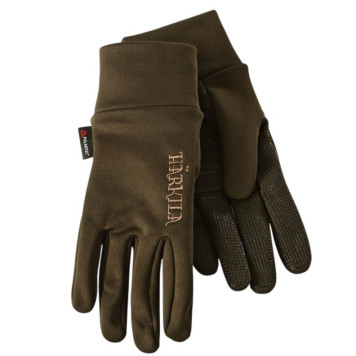
On a driven hunt or while stalking, your hands work constantly, so you need a thin, stretchy glove. Härkila Power Stretch gloves fit close to the palm and get in the way of nothing, from loading to marking a position on your phone. They come in willow green and shadow brown, so you can match them to your clothing. Härkila Metso Active and Seeland Climate suit mobile hunting in cool weather, and Browning Dynamic works on the shooting range too, where exact gun feel matters.
Camouflage gloves for stalking
Game sees your hands more often than you think: they move to your binoculars, your rifle, your face. Härkila Deer Stalker gloves are made in AXIS MSP Forest camouflage matched to a woodland background, while Seeland Hawker Scent Control gloves in PRYM1 camo also suppress human scent, which tells an animal more than movement does. For winter stalking, the Härkila Moose Hunter 2.0 in MossyOak pattern combines concealment with warmth.
Waterproof GTX gloves
Autumn drizzle soaks gloves faster than a jacket, because your hands touch wet branches and grass, drag game and hold a wet rifle all day. Härkila Pro Hunter GTX and Core GTX gloves carry a GORE-TEX membrane: water stays outside while sweat escapes through the fabric. A pair like this earns its place in October and November, when the temperature is still above freezing but damp follows you from dawn to dusk.
Warm winter gloves and mittens
A long sit in the high seat on a January morning numbs your fingers within half an hour if the gloves do not match the season. Härkila Mountain Hunter and Moose Hunter 2.0 are built for cold, passive waiting. Chevalier Nimrod Windblocker mittens hold heat better than fingered gloves, since the fingers warm each other, and the windproof shell protects you in an open tower. A mitten comes off quietly and fast before the shot.
Heated gloves
When passive insulation is no longer enough, active heat remains. Alaska Heat gloves have built-in heating that keeps finger temperature up through hours of sitting still. This pays off most in winter stalking and tower hunting, where you cannot warm up by moving and the chance of a shot arrives exactly when you least expect it. Warm fingers press a trigger as smoothly in January as in September.
How to choose hunting gloves
Start by answering one question honestly: which hunt will these gloves see most often, an active one or a passive one, in a dry season or a wet one. Thickness, membrane and construction all follow from that answer. Judge every pair in this order:
- Season and temperature. A thin pair covers spring to autumn; a winter or heated pair is needed for sitting still below zero.
- Hunting method. Pick stretchy models for driven hunts and stalking, warmer gloves or mittens for waiting, membrane gloves for wet weather.
- Size. The glove must fit snugly without pressing: too loose slips on the rifle, too tight cuts circulation and your fingers freeze sooner.
- Palm grip. A non-slip palm, as on the Chevalier No Slip, holds a wet stock and a drag rope.
- Colour. Green or brown works everywhere; camouflage matters where game sees you at close range.
Advice from the field
Experienced hunters carry two pairs in winter: a thin shooting glove and a warm mitten worn over it while waiting. Your hands stay warm all morning, and when the moment comes you never touch cold metal with bare skin. Dry your gloves at room temperature after every hunt, never on a radiator, because heat damages membranes and leather details. Store them with your hunting clothes, away from fuel and oil smells that game picks up from far off. Before the season, try the gloves on with your rifle in hand: check that your index finger passes freely into the trigger guard and that the palm holds firm on the grip.
Brands in this category
Härkila dominates the selection here, from thin Power Stretch gloves to winter Moose Hunter 2.0 and membrane Pro Hunter GTX models. Härkila is a Scandinavian hunting clothing maker whose designs are built for a northern climate close to Baltic conditions. Seeland offers the Climate and Hawker Scent Control models, Browning brings its shooting heritage with Tracker, Dynamic and Prohunter gloves, Chevalier makes grip gloves and windproof mittens, and Alaska Heat supplies the heated pair for the coldest days of the season.
Pair your gloves with the other accessories that protect fast-freezing parts of the body: socks, head covers and scarves and collars. If you are unsure about size or model, write to us and we will help you choose.