
9.3x62
9.3x62 cartridges for big game hunting: Norma Oryx, Vulkan and Ecostrike, RWS Evolution and UNI Classic, Geco Teilmantel and Express, Blaser CDC and lead-free Sax bullets. Weights run from 10 g to 19 g, covering driven hunts and high seat shooting for boar, deer and moose.
9.3x62
The 9.3x62 is one of Europe's most trusted big game calibers, and this category holds sixteen loads from five makers: Norma, RWS, Geco, Blaser and Sax. Bullet weights run from 10 g lead-free monolithics up to 19 g heavyweights, so you can match the load to driven boar hunts, red deer from a high seat or a moose hunt in the autumn woods. Below we explain how the bullet designs differ and how to pick a cartridge your rifle will shoot well.
What the 9.3x62 caliber is for
The 9.3x62 is built for large game at moderate distances: wild boar, red deer, moose and fallow deer. Its heavy 9.3 mm bullet carries a lot of energy and stops an animal even when it is running through thick cover with adrenaline up. That is why the caliber is a favorite on driven hunts. Berlin gunmaker Otto Bock designed it in 1905, and over more than a century it has become a European hunting classic. Recoil stays milder than in magnum calibers, which helps you stay on target and place a fast follow-up shot. In the field that means confident shooting out to roughly 200 meters, from a high seat, across a forest clearing or on the line of a driven hunt.
Cartridge types in this category
The selection falls into four bullet construction groups: bonded core, classic soft point, lead-free monolithic and special multi-purpose designs. Each group behaves differently inside the animal and beyond it, so the differences are worth understanding before you buy. All of these are hunting loads rather than target ammunition, so judge them by the game you hunt most often.
Bonded core bullets
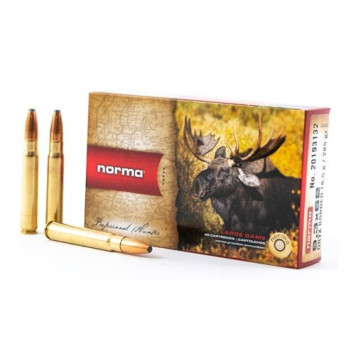
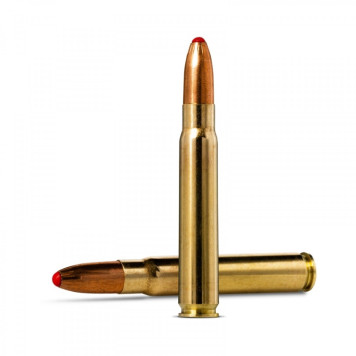
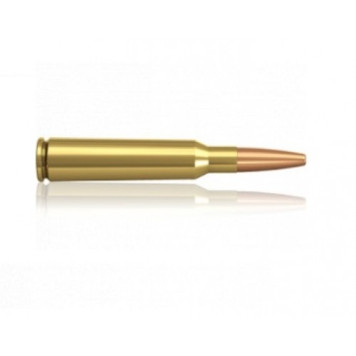
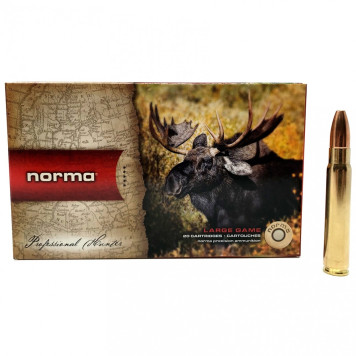
Norma Oryx in 15 g and 18.5 g is a bonded design: the lead core is fused to the jacket, so the bullet keeps most of its weight and penetrates deep. That suits a heavy boar or moose, where you need reliable effect even through the shoulder. RWS UNI Classic at 19.0 g works on a similar principle and is the heaviest load in this category.
Soft point bullets
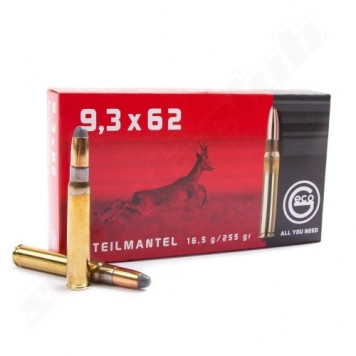
Geco Teilmantel 16.5 g, Norma PP 18.5 g and Norma Vulkan 15 g stand for the classic school: an exposed lead tip opens quickly and dumps energy inside the animal. They are a sound choice for deer at normal hunting distances, where fast effect and a clear blood trail matter most.
Lead-free monolithic bullets
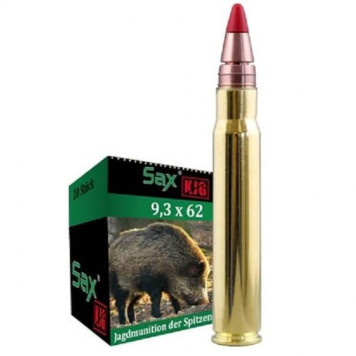
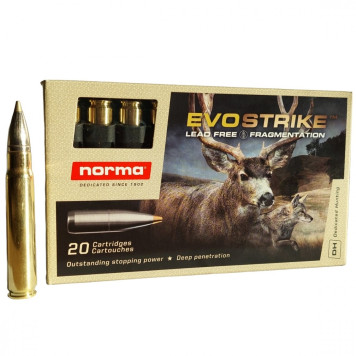
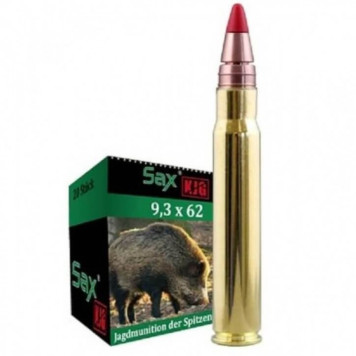
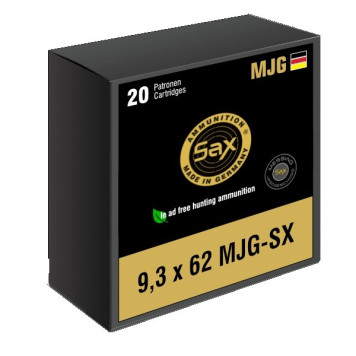
The lead-free choice here is wide: Norma Ecostrike 14.9 g and Evostrike 11.9 g, Blaser CDC 16.2 g, plus four Sax loads (KJG-SR 10 g, MJG-SX 10.29 g, KDG-S 13.1 g and KJG-BCS 15.8 g). Copper alloy monolithics are lighter, fly faster and leave fewer fragments in the meat. They matter to hunters who want no lead in their venison or hunt in grounds where lead-free ammunition is expected.
Special construction bullets
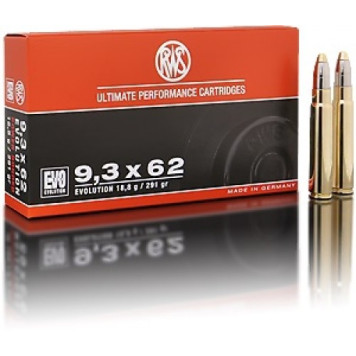
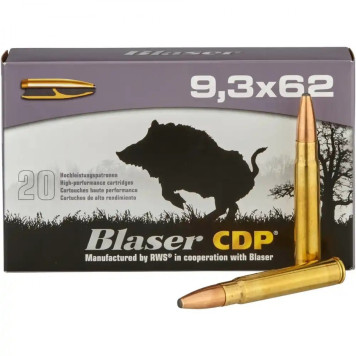
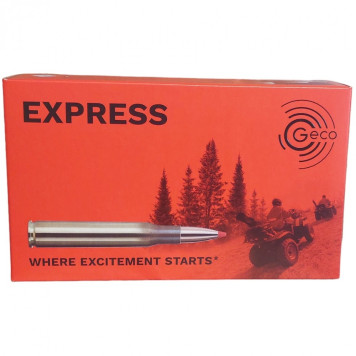
RWS Evolution 18.8 g pairs rapid expansion at the front with a solid rear section, so it performs across a wide span of distances. Geco Express 16.5 g is made for a flatter trajectory when you shoot farther than usual for this caliber. Blaser CDP 18.5 g is a two-part design for heavy game.
How to choose a 9.3x62 cartridge
Your choice comes down to the game, the hunting method and your rifle's preferences. There is no universal answer: the same barrel groups one bullet tightly and scatters another. So choose step by step and confirm the result at the range before the season opens.
- Name your main quarry: for moose and heavy boar pick 16 to 19 g bonded or monolithic bullets, for red and fallow deer the 15 g class is enough.
- Decide on lead: if the venison goes on your table and you want clean meat around the wound channel, look at Ecostrike, CDC or the Sax monolithics.
- Judge the distances in your grounds: on drives inside 100 m a heavy slower bullet has the edge, in open fields the faster Evostrike or Express loads earn their place.
- Mind your barrel twist: the light 10 g class Sax bullets need testing in your own rifle, because not every barrel stabilizes them equally.
- Buy at least two boxes for testing: zero the rifle, check your groups, and only then stock up for the whole season.
Bullet weight and markings
Load names state weight in grams and grains, for example 16.2 g equals 250 gr. One grain is 0.0648 grams, so a 285 gr bullet weighs 18.5 g. Weight shapes both trajectory and effect: a heavier bullet flies slower but penetrates deeper and is less deflected by twigs in driven-hunt cover, while a lighter one shoots flatter and makes aiming easier for a longer shot across open ground. In practice many hunters settle in the middle, around 15 to 16 g, and change loads only when their main quarry changes. One firm rule applies: after switching bullet weight, zero the rifle again, because the point of impact will move.
Practical advice in the field
The best cartridge is the one you have zeroed and whose behavior you know. Before the season, confirm your zero with the exact load you carry hunting, since bullets of different weights print differently on the target. On a driven hunt stay with one cartridge type for the whole day, so you never have to rethink your holds. Shooting from a high seat on a frosty morning, remember that the first shot from a cold barrel can land slightly away from your range zero. Store ammunition dry and at a stable temperature. When tracking after the shot, think about which bullet you fired: monolithics often leave a through wound channel and a clear blood trail, while fast-expanding loads more often drop the animal on the spot. Pushing through wet brush, carry your rounds in a closed magazine or pouch where they cannot rattle against each other as game closes in.
Brands
Five European makers are present in this category. Norma of Sweden offers the widest range, from Oryx to the lead-free Ecostrike and Evostrike lines. Germany's RWS and Geco represent the precision school with Evolution, UNI Classic, Teilmantel and Express loads. Blaser CDC and CDP cartridges serve the same demanding segment as the brand's rifles, and Sax specializes purely in lead-free copper bullets. All five names have long hunting ammunition pedigrees, so you can choose by bullet construction instead of guessing about quality.
If you also hunt with rifles in other calibers, see our .243 WIN. cartridges, 6.5x55 cartridges, 7x57 cartridges or .223 REM. cartridges. If you are unsure which load fits your rifle and your game, write to us and we will advise.